
Moving to Denver from Seattle — Your Complete Relocation Guide
I still remember the first Seattle transplant I ever helped move to Denver. She stepped off her flight in January, squinted at the sky, and said, "Wait — that's the sun? I forgot what it looks like." She'd spent six straight months under Seattle's gray ceiling, and here she was standing in 50-degree January sunshine. She cried a little. I'm not even exaggerating.
I'm Holly — Denver's Apartment Aunt and a licensed Colorado real estate broker — and I've helped dozens of people relocate from Seattle to Denver over the past few years. The Seattle to Denver relocation pipeline has become one of my busiest, especially since remote work opened the door for people who no longer need to be tethered to South Lake Union or the Eastside. As a dedicated apartment locator for Seattle movers, I've refined my process specifically for this route. My service is completely free for renters — the apartment communities compensate me, so you get a local expert at no cost to you.
If you're sitting in a Ballard coffee shop right now, scrolling your phone while rain streaks down the window, wondering if there's a city that has everything you love about Seattle minus the parts that are slowly draining you — keep reading. Denver might be exactly what you're looking for.
Start Your Apartment Wishlist →
Seattle vs. Denver: Which City Actually Fits Your Lifestyle?
Let me be real with you — Denver is not Seattle with sunshine. It's a fundamentally different city, and I want you to know exactly what you're getting before you pack a single box. I've watched people move here and absolutely thrive, and I've seen a few move back because they expected a copy of the Pacific Northwest with better weather. So let's compare honestly.
The Sunshine (Yes, It's Real)
Denver averages over 3,000 hours of sunshine annually and around 252 sunny or partly sunny days per year. Seattle? About 152. That difference hits you physically. Almost every Seattle transplant I've worked with tells me their mood improved within the first month. Not just "I like sunny days" improved — measurably improved. One client, a software engineer who relocated from Redmond, told me his therapist noticed the change before he did.
The Mountains (Rockies vs. Cascades)
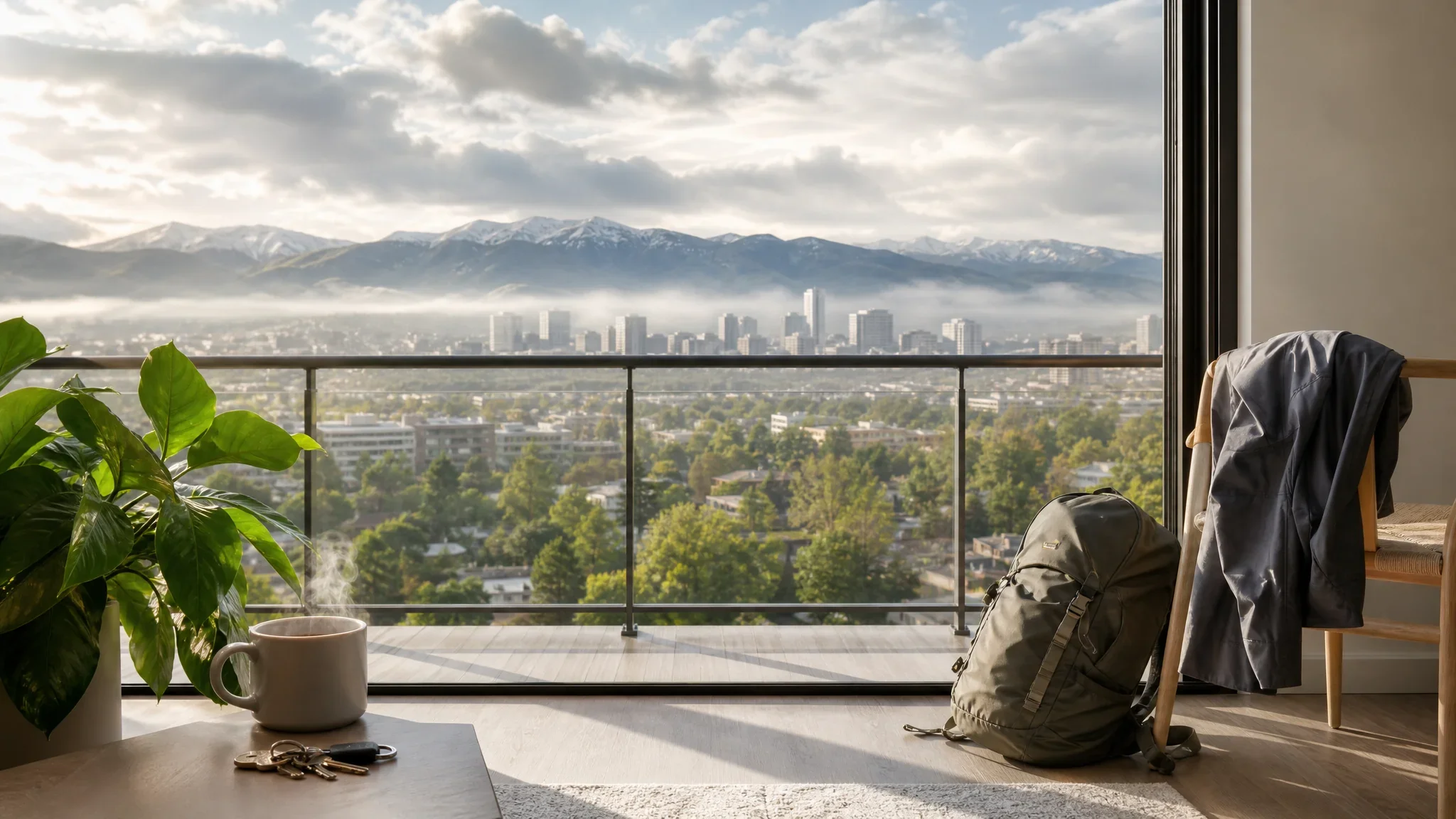
Both cities are mountain cities — but the relationship with those mountains is completely different. In Seattle, you might see Rainier on a clear day. In Denver, you see the entire Front Range from your apartment balcony almost every single morning. The Rockies are right there, 30 minutes from your doorstep. And while the Cascades are stunning, nothing compares to waking up to a 200-mile wall of 14,000-foot peaks glowing pink at sunrise.
Outdoor Access
This is where Seattle people light up. You already live for the outdoors — hiking, skiing, kayaking, biking. Denver takes that and multiplies it by about 300 days of usable weather. In Seattle, your hiking season has a window. In Denver, I've hiked in shorts in February. The trail systems here are extraordinary: Red Rocks, Mount Falcon, Waterton Canyon, and dozens more — all within 30–45 minutes of downtown. And ski season? You're 90 minutes from some of the best resorts in North America: Breckenridge, Keystone, Arapahoe Basin, Copper Mountain.
The "Freeze" Factor
If you've lived in Seattle long enough, you know the Seattle Freeze — that phenomenon where everyone is polite, pleasant, and completely uninterested in becoming your actual friend. Denver is different. The transplant culture here is massive (most people you meet moved here from somewhere else), and the social scene is much more open. I've had multiple clients tell me they made more friends in their first three months in Denver than they did in years in Seattle. The sunshine helps — people are just outside more, and that creates natural social opportunities that Seattle's rain doesn't.
What Seattle Tech Workers Are Surprised By After Moving to Denver
I've helped enough Amazon, Microsoft, Boeing, and Expedia employees relocate to Denver that I've started keeping a mental list of things that consistently surprise them. Here's the unfiltered version:
1. Your paycheck goes further — a lot further.
The overall cost of living in Denver is roughly 20–30% lower than Seattle. The biggest driver is housing: a one-bedroom apartment that runs $2,300+ in Capitol Hill Seattle or $2,500+ in South Lake Union costs $1,700–$2,200 in most desirable Denver neighborhoods. That's real money back in your pocket every single month. Check my Denver Renter's Guide for the full breakdown of what to expect.
2. Colorado has a state income tax — but the math still works.
Washington has no state income tax, so this trips people up. Colorado's flat rate is 4.4%. But when your rent drops by $500–$800/month, the tax difference is more than offset. I always tell clients to run the full numbers, not just look at the tax line. The net savings from housing, groceries (about 5–8% cheaper), and transportation usually leave Seattle transplants ahead by $800–$1,200 per month.
3. Denver's tech scene is bigger than you think.
Denver isn't trying to be the next Seattle or San Francisco — it's building its own thing. The Denver-Boulder tech corridor is home to major operations from Google, Oracle, Arrow Electronics, and hundreds of startups. Average tech salaries here run around $120,000, and while that's lower than Seattle's inflated numbers, the purchasing power is significantly higher. Many of my clients keep their Seattle-based remote salaries and live like royalty here.
4. You'll actually use your REI membership.
In Seattle, you buy gear for the three months of summer hiking. In Denver, you use it year-round. Skiing, snowshoeing, mountain biking, trail running, rock climbing — there's never an off-season. I've had clients tell me their cost-per-use on outdoor gear went from embarrassing to exceptional within a year.
5. The altitude is real.
Denver sits at 5,280 feet. Seattle is essentially at sea level. Almost everyone feels the altitude for the first week or two — mild headaches, getting winded on stairs, needing more water. It passes. But I always warn my clients: don't plan a 14er hike your first weekend. Give your body two to three weeks to adjust. And drink more water than you think you need.
6. The dryness will shock you.
Seattle's humidity averages 73–80%. Denver's hovers around 35–40%. Your skin will revolt. Your lips will crack. You'll discover that chapstick and a good moisturizer are survival tools, not luxuries. Invest in a humidifier for your apartment — your sinuses will thank you. (Yes, I tell every single Seattle client this. Yes, they always underestimate it.)
Rain Jackets vs. Ski Jackets: A Lighthearted Gear Swap Guide
Moving from Seattle to Denver requires a complete wardrobe rethink. Here's what changes:
Your rain jacket collection? You'll wear one maybe 15 days a year. Denver gets about 57 inches of snow annually, but rain is sparse — only about 86 days of measurable precipitation total, and most of it comes as quick afternoon thunderstorms in summer that blow through in 20 minutes.
Your umbrella? Locals don't use them. When it rains, you wait 10 minutes and it stops. When it snows, it melts by noon. Seriously — Denver snow is dry, light, and often gone the next day.
What to buy instead: A solid ski jacket, sunglasses you actually like (you'll wear them almost daily), sunscreen (the UV at altitude is intense), and layers. Denver's daily temperature swing can be 30–40 degrees. A 70-degree afternoon can follow a 35-degree morning.
Keep your hiking boots. They'll finally earn their cost-per-wear.
Ditch the waterproof everything. You won't need Gore-Tex-lined pants, waterproof backpacks, or splash-proof phone cases. The desert air is your new reality.
Denver Neighborhoods That Feel Familiar to Seattle Transplants
This is the section I'm most qualified to write, because I've literally walked dozens of Seattle transplants through this exact exercise: "I love my Seattle neighborhood — what's the Denver equivalent?" Here are the matches I recommend most often, based on objective neighborhood data:
If You Love Capitol Hill, Seattle → Look at Capitol Hill, Denver
Yes, they share a name, and the vibe overlap is uncanny. Seattle's Capitol Hill is walkable, packed with restaurants and live music venues, and has a strong independent-business culture. Denver's Capitol Hill mirrors that almost exactly — Walk Score in the 90s, the highest concentration of bars, restaurants, and music venues in Denver, and the kind of neighborhood character that feels lived-in rather than manufactured. It's Denver's most walkable neighborhood and one of the few where going completely car-free is genuinely practical.
1BR rent: $1,900–$2,500 · Walk Score: 88–96
If You Love Ballard or Fremont → Look at LoHi or Sloan's Lake
Ballard's mix of brewery culture, trendy restaurants, and neighborhood pride translates directly to LoHi — Denver's hottest restaurant corridor with walkable streets and stunning mountain views. If you lean more toward Fremont's quirky, laid-back energy, Sloan's Lake offers a similar community feel plus Denver's best urban lake with a 2.6-mile loop trail — your Greenlake replacement, essentially.
LoHi 1BR rent: $1,900–$2,600 · Walk Score: 80–85
Sloan's Lake 1BR rent: $1,700–$2,300 · Walk Score: 70–80
If You Love South Lake Union or Bellevue → Look at Denver Tech Center or Cherry Creek
If your Seattle life revolves around a polished, amenity-rich apartment near a major employment hub, the Denver Tech Center is your match — newer construction, easy highway access, and proximity to the southeast tech corridor. If you want that same polish but closer to urban culture, Cherry Creek is Denver's version of Bellevue's upscale walkability — high-end retail, excellent dining, and a refined residential feel.
DTC 1BR rent: $1,700–$2,200 · Walk Score: 40–55
Cherry Creek 1BR rent: $2,000–$2,800 · Walk Score: 75–85
If You Love Pioneer Square or the Waterfront → Look at Union Station / LoDo
Seattle's historic core and waterfront energy maps closely to Denver's Union Station / LoDo district. It's Denver's transit hub, with light rail connections, walkable streets, and proximity to Coors Field and the Performing Arts Complex. Walk Score in the 90s.
1BR rent: $2,000–$2,800 · Walk Score: 90+
If You Love Wallingford or Green Lake → Look at Washington Park
The tree-lined residential feel of Wallingford — with its neighborhood parks, jogging paths, and quieter pace — lines up with Washington Park. The park itself is Denver's version of Green Lake: a gorgeous loop trail, flower gardens, and that neighborhood-within-a-city atmosphere. Great for people who want walkability to local spots without the intensity of a nightlife district.
1BR rent: $1,700–$2,300 · Walk Score: 70–80
If You Love the Arts and Brewery Scene → Look at RiNo
Seattle has its brewery culture. Denver lives its brewery culture. RiNo (River North Art District) is Denver's creative hub — converted warehouses, street art murals on every block, food halls, and more craft breweries per square mile than anywhere in the state. If you're a fan of Ballard's taproom crawl or Fremont Brewing, you'll feel right at home.
1BR rent: $1,900–$2,600 · Walk Score: 75–85
Not sure which neighborhood is right? That's literally my job. Fill out your Apartment Wishlist and tell me what you loved about your Seattle neighborhood — I'll match you with Denver equivalents.
Seattle vs Denver Cost of Living — The Real Breakdown
The Seattle vs Denver cost of living question is the first thing almost every client asks me. I won't sugarcoat it: Denver isn't cheap anymore. But compared to what you're paying in Seattle, the savings are real and immediate. Here's the honest comparison:
Rent (The Big One)
Seattle 1BR average: $2,260/month
Denver 1BR range: $1,700–$2,200/month depending on neighborhood
Seattle 2BR average: $2,630/month
Denver 2BR range: $2,600–$3,200/month depending on neighborhood
Monthly savings potential: $300–$700 on rent alone
Beyond Rent
Groceries: 5–8% lower in Denver than Seattle
Transportation: Gas and car costs run 20–30% lower. Denver's light rail system (RTD) connects major corridors, though most Seattleites will tell you they miss Link Light Rail's frequency.
Healthcare: Comparable, with Denver slightly lower on average
Dining out: Noticeably cheaper. A good dinner for two in Denver runs $70–$100; the same quality in Seattle hits $100–$140
The Tax Trade-Off
Washington has no state income tax. Colorado's is 4.4%. On a $120,000 salary, that's roughly $5,280 annually. But most of my Seattle clients save $6,000–$9,000 per year on housing alone, plus thousands more on everyday expenses. The net math almost always favors Denver.
Coffee Culture: Yes, Denver Has Good Coffee
I know this is a genuine concern for Seattle people, and I'm not going to pretend it's not. You're coming from the global capital of coffee culture. You've had your regular barista. You have opinions about pour-over methods.
Denver's coffee scene won't replace Seattle's — but it will genuinely impress you. The craft roaster game here is strong: Huckleberry, Corvus, Sweet Bloom, Little Owl, and Middle State are all doing specialty-grade work that would hold their own on Capitol Hill (the Seattle one). Most Denver neighborhoods have excellent local roasters within walking distance. You won't find a Starbucks Reserve Roastery here, but you also won't find yourself drinking bad coffee.
What Denver does add to your coffee experience: patios. Real, usable, sunshine-drenched patios. You'll drink your cortado outside in December. That alone is worth the move for some people.
Your Seattle-to-Denver Moving Timeline
Based on the dozens of Seattle-to-Denver relocations I've managed, here's the timeline that works best:
60–90 Days Before Your Move
Fill out your Apartment Wishlist so I can start curating options
Research neighborhoods using my Denver Renter's Guide and Neighborhood Hub
If you're job-searching, begin exploring the Denver-Boulder tech corridor
Start decluttering — moving costs from Seattle to Denver average $3,500–$6,000 for a full household, so less stuff = lower cost
30–45 Days Before Your Move
I'll send you a curated list of apartments matched to your criteria
If you're visiting Denver, we'll schedule tours together. If not, I'll tour apartments on your behalf and send detailed video walkthroughs
Get moving quotes from at least three companies
Notify your Seattle landlord per your lease terms
14–30 Days Before Your Move
Sign your Denver lease (I'll review everything with you)
Set up utilities — Xcel Energy for electric/gas, Denver Water for water
Update your address with USPS, banks, subscriptions
Within 30 days of moving: get your Colorado driver's license and register your vehicle (Colorado requires both)
Your First Week in Denver
Stock up on moisturizer, sunscreen, and a reusable water bottle (altitude + dryness = hydration is essential)
Download the RTD app for transit, and Uber/Lyft for backup
Take it easy on the altitude — no summit hikes for at least two weeks
Explore your neighborhood on foot. Walk to the nearest coffee shop. Sit on a patio in the sunshine. Breathe.
Frequently Asked Questions: Moving from Seattle to Denver
Is Denver really sunnier than Seattle?
Dramatically. Denver averages over 3,000 hours of sunshine per year with roughly 252 sunny days. Seattle gets about 2,170 hours and only 152 sunny days. The difference isn't subtle — it changes how you live, how you feel, and how you plan your weekends. You'll stop checking weather apps because the answer is almost always "sunny."
Will I miss the water?
Some people do, genuinely. There's no Puget Sound equivalent in Denver — it's a landlocked city. But Sloan's Lake, Cherry Creek Reservoir, Chatfield Reservoir, and Standley Lake provide on-the-water recreation. And many Seattle transplants tell me they trade "water views" for "mountain views" and never look back. It's a different kind of stunning.
How's Denver's public transit compared to Seattle?
Honest answer: it's not as strong. Seattle's Link Light Rail is more frequent and covers more ground. Denver's RTD light rail connects the airport to downtown and extends to the suburbs, but service frequency can be inconsistent. Most Denver residents own cars. If you're planning to live car-free, neighborhoods like Capitol Hill (Walk Score 90+) and Union Station (Walk Score 90+) are your best options.
Is the "Seattle Freeze" really a thing, and is Denver different?
Yes, and yes. The Freeze is real — polite but distant. Denver's social culture is genuinely warmer. Because so many residents are transplants themselves, people are actively looking to build friendships. The sunshine factor helps too — it's easier to meet people when everyone's at a patio, a trailhead, or a brewery on a Tuesday evening. Multiple clients have told me they built a stronger friend group in their first six months in Denver than they managed in years in Seattle.
What about the altitude? Should I be worried?
Denver is at 5,280 feet — the Mile High City. Most people feel mild effects for the first one to two weeks: slight headaches, getting winded easier, needing more sleep. It passes quickly. Drink extra water (aim for a gallon a day initially), limit alcohol your first few days, and don't push intense exercise right away. If you have specific health concerns, talk to your doctor before the move.
Can I keep my remote Seattle salary and live in Denver?
Many of my clients do exactly this, and it's the best of both worlds. A Seattle-level tech salary paired with Denver's cost of living creates significant disposable income. Just be aware that some employers adjust compensation based on location, and you'll owe Colorado state income tax (4.4%) instead of Washington's zero. Even with the tax, the math heavily favors Denver.
What's the driving distance from Seattle to Denver?
About 1,315 miles, or roughly 20 hours of driving. Many of my clients turn it into a two-day road trip through Montana or Wyoming and actually enjoy the journey. If you're flying, direct flights run about 2 hours 45 minutes — Alaska Airlines, United, Southwest, and Frontier all operate the route frequently.
When's the best time to move?
For the best apartment deals, move between October and February — landlords offer more concessions, and competition drops significantly. May through August is peak season with higher prices and faster turnover. I track availability year-round, so start your Wishlist whenever you're ready and I'll find options at the best possible pricing.
How Holly Helps Seattle Transplants Find Their Denver Apartment
Here's exactly how my process works — it's designed for long-distance relocators, so everything can happen remotely if needed:
Fill out your Apartment Wishlist — Takes about 2 minutes. Tell me your budget, move-in date, must-haves, and what you loved about your Seattle neighborhood.
I curate your matches — Based on your priorities, I'll create a personalized list of Denver apartments. Not a generic search — a hand-picked selection from someone who knows every building in this city.
We tour together (or I tour for you) — If you're visiting Denver, we'll schedule tours around your trip. If you can't make it out before your move, I'll tour apartments on your behalf and send you detailed video walkthroughs with honest commentary.
You sign, I stay with you — I'm here through lease signing, move-in, and beyond. If something goes wrong with your apartment in month three, you can still call me.
My service is completely free for renters. The apartment communities compensate me, which means you get a licensed local expert, personalized neighborhood matching, and someone who's done this dozens of times — at no cost to you. No hidden fees. No strings attached. Learn more on my How It Works page, or check my FAQ for common questions about my process.
If you're ready to trade the gray for the sunshine, I'd love to help you find your Denver apartment.
Start Your Apartment Wishlist →
Let's Find Your Denver Apartment
I've helped hundreds of renters — including dozens from Seattle — find their perfect Denver apartment. You're next.
Holly The Locator is a registered trade name of Holly Van Keuren, a licensed Colorado Real Estate Broker with Relive Real Estate #FA.100109083. Serving the Denver Metro Area. Phone: 303-442-2625.